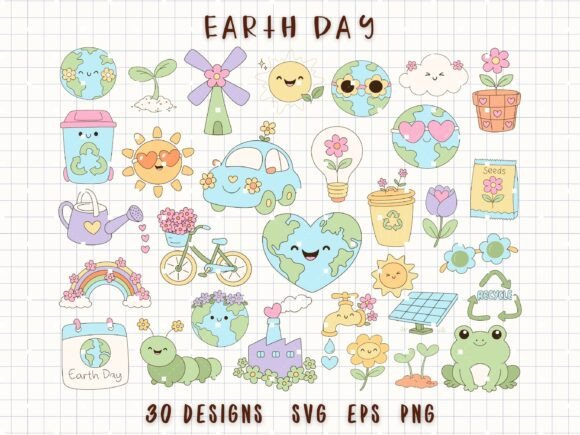
Earth Day Clipart Cute Eco Planet SVG: A Designer's Guide
Every spring, the same challenge appears on creative briefs and marketing calendars: how to visually communicate environmental consciousness in a way that feels fresh, positive, and engaging. We move past the tired stock photos of someone holding a globe and look for imagery with more personality. This is precisely where a resource like the Earth Day Clipart Cute Eco Planet SVG collection finds its purpose. It’s not just a set of cute drawings; it’s a cohesive visual language designed to express care for our planet with warmth and charm.
At its core, this collection is built on a kawaii-inspired aesthetic, characterized by soft, rounded forms, friendly faces on inanimate objects, and a gentle, pastel color palette. You won’t find harsh lines or aggressive gradients here. Instead, the designs—a smiling Earth character, a cheerful recycling symbol, a contented frog on a lily pad—project an approachable sense of optimism. This style is incredibly effective because it disarms. It makes complex topics like sustainability and environmental responsibility feel accessible and even joyful. For a designer or content creator, this is a powerful tool. It allows you to build campaigns, products, or educational materials that resonate emotionally without feeling preachy or heavy-handed. The overall appeal lies in its ability to be both purposeful and delightful, a combination that stands out in a crowded visual landscape.
Where This Style Truly Shines: Practical Applications
The true value of any design asset is measured by its versatility. The Earth Day Clipart Cute Eco Planet SVG bundle excels across a surprising range of projects, acting as a versatile component in your creative toolkit. Think beyond a single holiday. These graphics are perfect for building a sustained brand identity for any business with an eco-friendly or wellness focus. A small-batch soap company, a local organic farm, a yoga studio, or a sustainable fashion brand could use these elements to craft a logo, design product packaging, and create a cohesive social media presence that feels authentic and aligned with their values.
For educators and publishers, the applications are immediately clear. The charming illustrations are ideal for classroom decorations, interactive learning worksheets, and children’s activity books that teach recycling or conservation. They transform a standard worksheet into an engaging experience. In the digital realm, these assets are gold for bloggers and content creators. They make excellent featured images, can be used to create eye-catching infographics about eco-tips, and are perfect for designing a series of Instagram Stories or Pinterest pins that promote environmental awareness campaigns. The SVG format is particularly valuable here, ensuring every line and curve remains crisp whether you’re scaling it for a website header or a small icon.
For the crafters and small business owners in the audience, this collection is a direct path to product creation. The designs are perfectly suited for die-cut machines to make stickers, planner decals, and greeting cards. Imagine offering a set of Earth Day stickers on Etsy or using the illustrations to create unique, printable wall art for a nursery. The commercial license that typically accompanies such premium digital art files means you can confidently incorporate these designs into physical and digital products for sale, turning your creative passion into a viable offering.
Integrating the Graphics: A Strategic Approach
Using a themed clipart bundle effectively requires more than just slapping a graphic onto a page. It’s about integrating it into your broader design strategy. First, consider your project’s tone. While the cute eco planet SVG style is friendly, it might not be the right fit for a corporate sustainability report aimed at investors. It thrives in contexts where approachability and consumer engagement are key. Evaluate if the playful personality aligns with your brand voice and your audience's expectations.
Next, think about composition and hierarchy. These illustrations are fantastic as supporting elements, but they can also be focal points. Use a larger, detailed Earth character as the centerpiece of a poster, surrounded by smaller icons of solar panels, windmills, and bicycles to tell a more complete story. In web design, a repeating pattern of the simpler motifs could create a charming background texture for a blog sidebar or a footer. The key is to use the graphics to support your message, not overwhelm it. A single, well-placed sprouting plant icon next to a call-to-action can be more powerful than a dozen scattered elements.
Finally, pay attention to consistency. The strength of a bundle like this is its unified style. Stick to the provided color palette or create your own limited palette derived from it to ensure all your materials look like they belong together. When pairing these illustrations with typography, opt for fonts that complement rather than compete. A clean, modern sans-serif font for body text works beautifully, allowing the playful clipart to stand out. For headlines, a simple, friendly handwritten font or a rounded sans-serif can echo the approachable vibe of the graphics. By treating the Earth Day Clipart collection as part of a larger design system, you move from simply decorating to strategically communicating a powerful, positive message about our planet. It becomes a foundational piece of your visual identity, one that connects with your audience on a genuinely human level.